
Decatur Directory Runs and Access
Decatur Public Library states that its Local History Room holds city directories from 1871 to today. That broad span does not mean every year is online or that each publisher is named in the web catalog. The strongest approach is to use the known digital volumes first, then ask library staff for a year-by-year shelf check. Early Decatur material includes the Wiggins & Co. 1871 history and business directory, Charles O. Ebel's directory work beginning in 1883, a digitized 1906 Ebel volume, and a 1910 Huston-Patterson scan. References to 1912 and 1920 editions also need page or shelf confirmation.
| Directory source | Documented span | Keeper | How to read it |
|---|---|---|---|
| DPL city directories | 1871 to today, as stated by DPL | Local History Room | Shelf, selected digital items, and staff request |
| Wiggins & Co. history and business directory | 1871 | University of Illinois digitization | Free page-image PDF |
| Ebel's Decatur City Directory | 1906 digitized; Ebel work began in 1883 | DPL Omeka | Free image-based PDF and collection record |
| Huston-Patterson directory | 1910 scan; 1912 and 1920 references | Google Books and DPL shelf check | Search snippets plus scanned pages |
| Reverse or criss-cross volumes | Exact titles and years not listed online | DPL Local History Room | Ask staff for an address-order shelf inventory |
The official sources do not give a complete publisher sequence, a last printed year, or a verified run of reverse books. Do not fill those gaps with assumed titles. Ask for the year, publisher, ordinary-name section, address section, and business section. This keeps the Decatur city directory search tied to an actual volume instead of a guessed series.
Decatur Directory Desk at DPL
The Decatur Public Library Local History Room is the main offline route when a digital search stops. It is at 130 N Franklin Street, with phone service at 217-421-9766. Listed hours are Monday through Friday, 10:00 to 5:00, with Saturday visits by appointment and Sunday closed. Remote researchers may call or email. A precise request works best: give a surname, a directory year, an address spelling, or an obituary citation instead of asking for a broad resident list.
The room also connects a city directory find to maps and plat books, newspaper microfilm, photos, local histories, phonebooks, organization minutes, cemetery lists, and manuscript material. ArchivesSpace supplies box and folder descriptions. Omeka hosts digitized items and receives weekly uploads. Licensed databases, including Ancestry Library Edition, HeritageQuest, Fold3, and NewspaperArchive, may require use at a library terminal, so online catalog visibility does not always mean remote access.
The DPL digitized directory collection shows how the library groups the surviving scans.
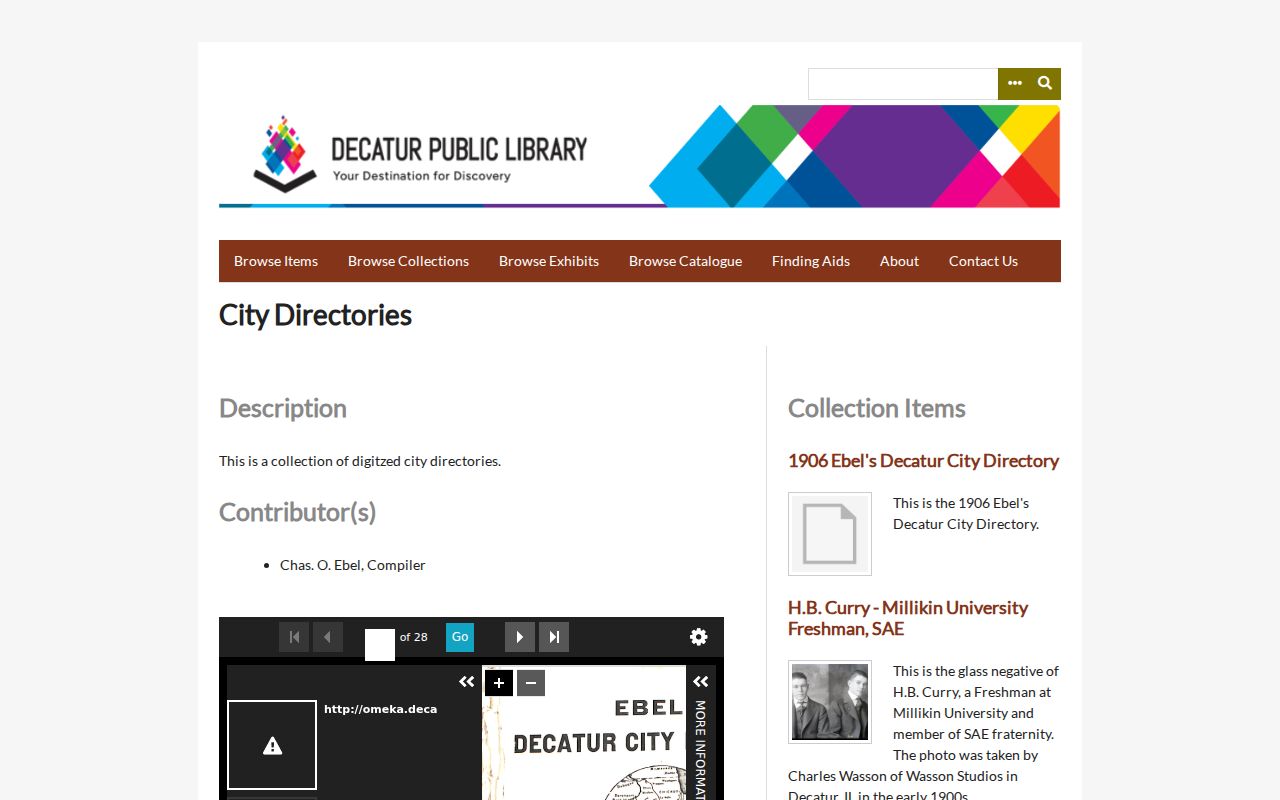
The collection view is a starting point, but each item's file format and text-search support must still be checked.
Ebel Gave Decatur Addresses Order
Charles O. Ebel's work is more than a publisher note. A DPL biography says his first directory appeared in 1883 and that he compiled or published directories for 31 years. It also credits him with numbering Decatur homes and putting up the first street signs. That makes an Ebel volume a key bridge between a resident's printed address and the city's changing address system.
The 1906 title was produced by Review Printing and Stationery Company. Its DPL record identifies addresses, households, and businesses as subjects. The scan is made of page images, and the inspected file did not yield searchable OCR text. Browse the alphabetical pages, consult the printed index, and save the abbreviation page before copying an entry.
The 1906 Ebel city directory item presents the library metadata and digital files.
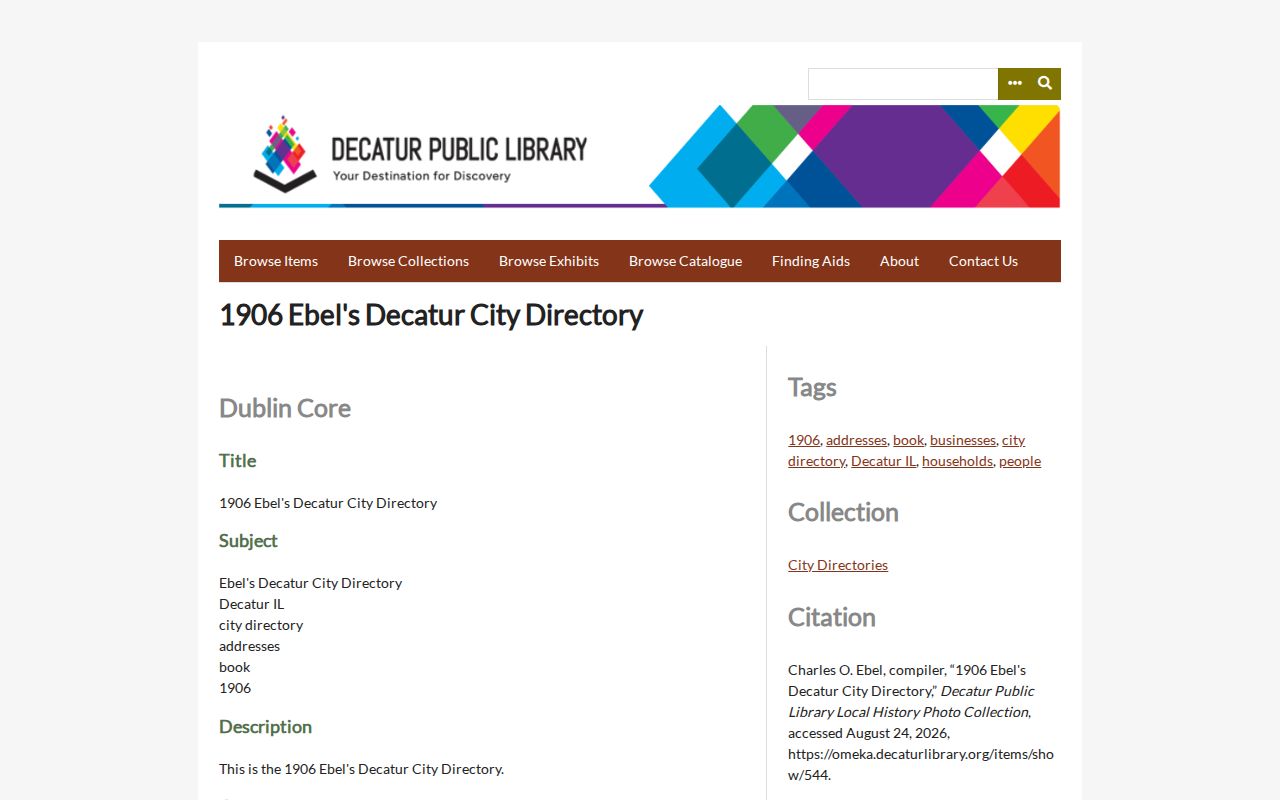
That item confirms the compiler and producer while warning, through its image format, that a failed text search does not mean the name is absent.
| 1871 | Wiggins & Co. history with a classified business directory |
|---|---|
| 1883 | Ebel's first directory, according to his DPL biography |
| 1906 | Ebel volume digitized by DPL |
| 1910 | Huston-Patterson directory available as a Google Books scan |
Read a Decatur Directory Entry
The 1910 Huston-Patterson scan shows how much can fit on one short line. Inspected entries include surname and given name, a title such as “Miss,” a widow note, an abbreviated role, a named company, the marker “res,” and a street address. One entry may therefore identify a person and give useful social context, but it remains a publication-year statement. It is not a deed or proof of present residence.
| Name form | Surname, given name, initials, and status terms as printed |
|---|---|
| Role | Abbreviations such as clk, Pres, Treas, or Supt, often followed by a company |
| Residence | The marker res followed by the house number and abbreviated street |
| Widow note | wid followed by the deceased spouse's given name |
| Year context | The address belongs to that edition and should be checked in nearby years |
- Criss-cross directory
- A directory arranged by street and house number rather than by surname. DPL has not published exact Decatur titles or years, so request a shelf check.
- Householder index
- An address-based list of the person identified with a home. The label does not by itself prove ownership.
- Abbreviation key
- The volume's own list explaining short forms. Read it before interpreting roles, marital notes, or address marks.
The 1910 Decatur directory scan offers search-within-volume snippets and page images.
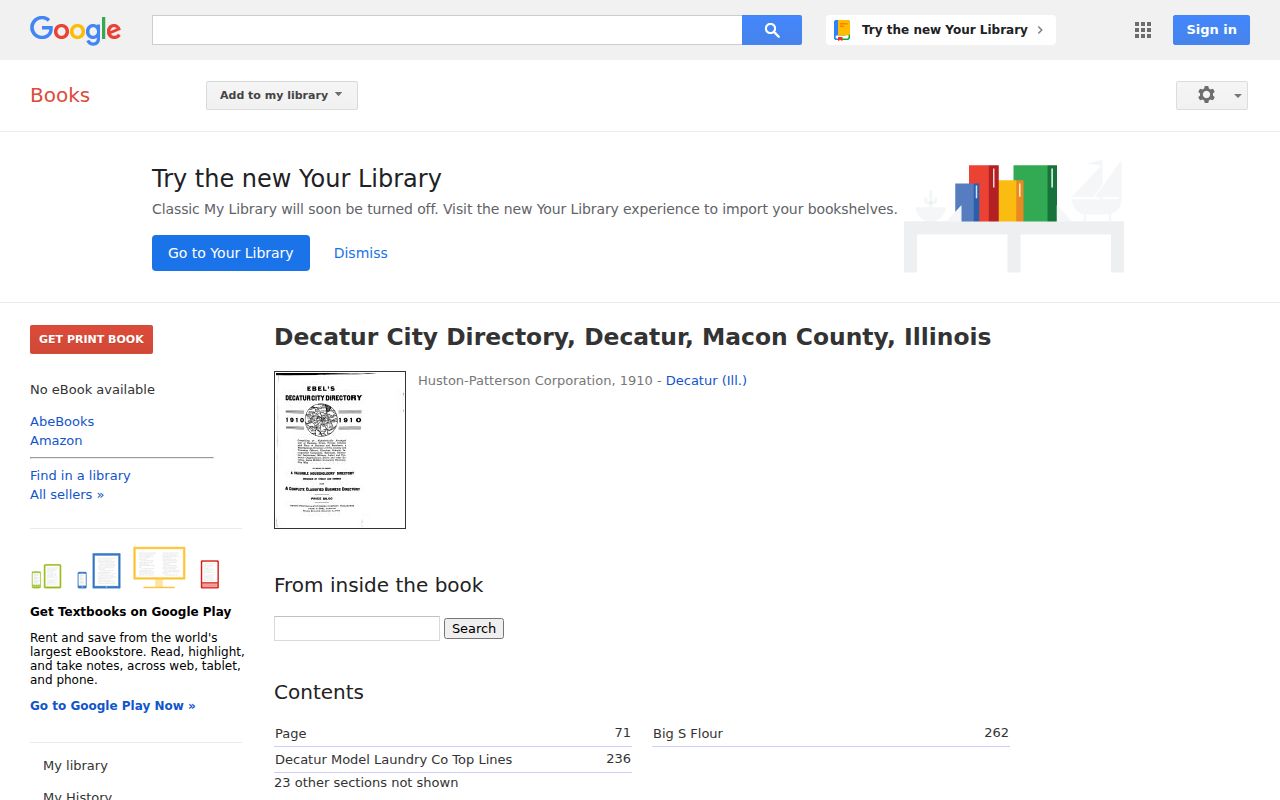
The image shows why punctuation and nearby lines should be read on the page, not copied from an isolated search snippet.
Decatur Obituaries Extend the Trail
A person who disappears from one directory year may have moved, died, changed name form, or simply gone unlisted. DPL's obituary index offers a strong next check. It reports 160,729 records and draws from the Daily Review for 1878 to 1931, Evening Review for 1931 to 1980, and Herald & Review from 1980 to the present. Search fields include first and last name, maiden name, burial place, funeral home, and a year range.
The Decatur obituary index supplies the searchable citation layer.
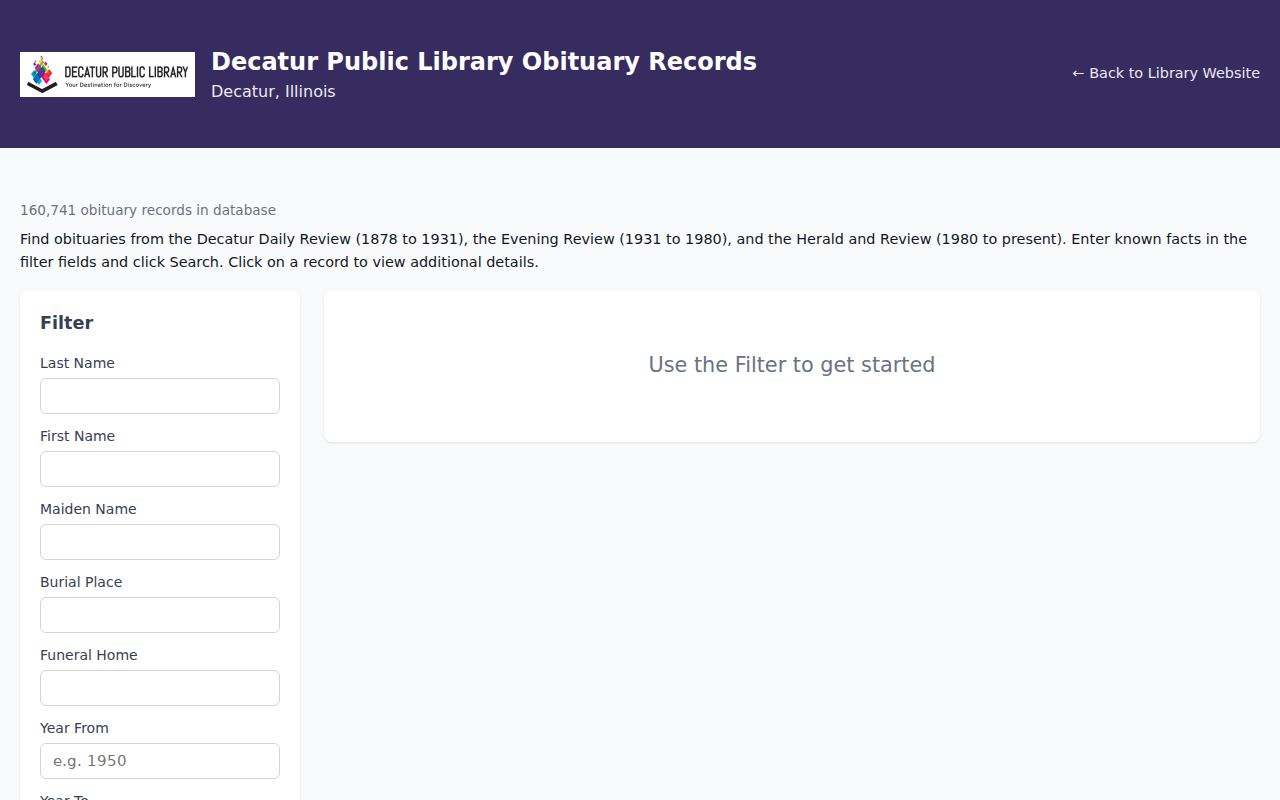
An index hit identifies where to look next. Read the newspaper image or microfilm for the full notice, then compare names and addresses with the directory.
Digitized papers also include the Decatur News, Decatur Herald, Decatur Advertiser, and Vindicator in their documented runs. Coverage varies by title. Ask DPL for microfilm when an issue is absent online, and record the paper, date, and page for each finding.
Decatur Archives Beyond Directories
Several Decatur repositories can resolve a gap that one city directory cannot. The Macon County Historical Museum maintains a museum, library, and archive at 5580 N Fork Road. It is open Tuesday through Saturday from 1:00 to 4:00, but its site does not expose an item-level catalog. Ask about a named family, school, business, church, organization, house, or neighborhood.
The Decatur Genealogical Society library at 1255 W South Side Drive is staffed Wednesday and Saturday from 10:00 to 4:00. Its cataloged books, film, fiche, CDs, and indexes are especially useful after a DPL or Illinois Regional Archives Depository result points toward a surname. Millikin University Archives adds the Decaturian from 1903 through June 1951, Millidek yearbooks from 1906 through 1999, photos, and university records. Public research access is available at Staley Library.
For city directories, keep each repository in its lane. DPL owns the broad local shelf. The historical museum offers county context, the genealogical society brings donated research collections, and Millikin supplies institutional and classmate evidence.
Trace Family Through Decatur Directories
Use each Decatur city directory as one dated frame, then join the frames with census, deed, obituary, and map evidence. Start from the clearest known spelling and address. Search the nearest volume on both sides of the target year because publication dates and move dates rarely align. A missing name is a question, not a conclusion.
- Write the exact street number, direction, street spelling, and surname from the first reliable source.
- Check the ordinary-name section before and after the target year. Save initials, widow notes, roles, and every address change.
- Ask DPL whether that year has a true address-order or criss-cross section. Read all names shown at the same address.
- Pair directory years with the public 1870 through 1950 federal censuses. The 1960 census is not yet generally open under the 72-year rule.
- Test a transition with a deed, tax-card sale, obituary, probate file, permit, newspaper item, or cemetery entry.
A deed identifies a recorded ownership event, while a city directory records a published residence statement. Those facts may involve different people. A seller may never have lived at the property, and a relative at an address may not be the owner. For a modern address-based chain, continue with the Decatur street directory workflow instead of forcing an old volume to answer a current parcel question.
Decatur Directory Names at Greenwood
Burial evidence can close a family-history trail without making claims about a current address. Greenwood Cemetery's search returns an interment number, block, lot, grave or niche, burial date and type, mortuary, birth and death details, and attachments where present. Pair those fields with a DPL obituary citation and the final city directory appearance.
The Greenwood interment search is the direct name-search route.
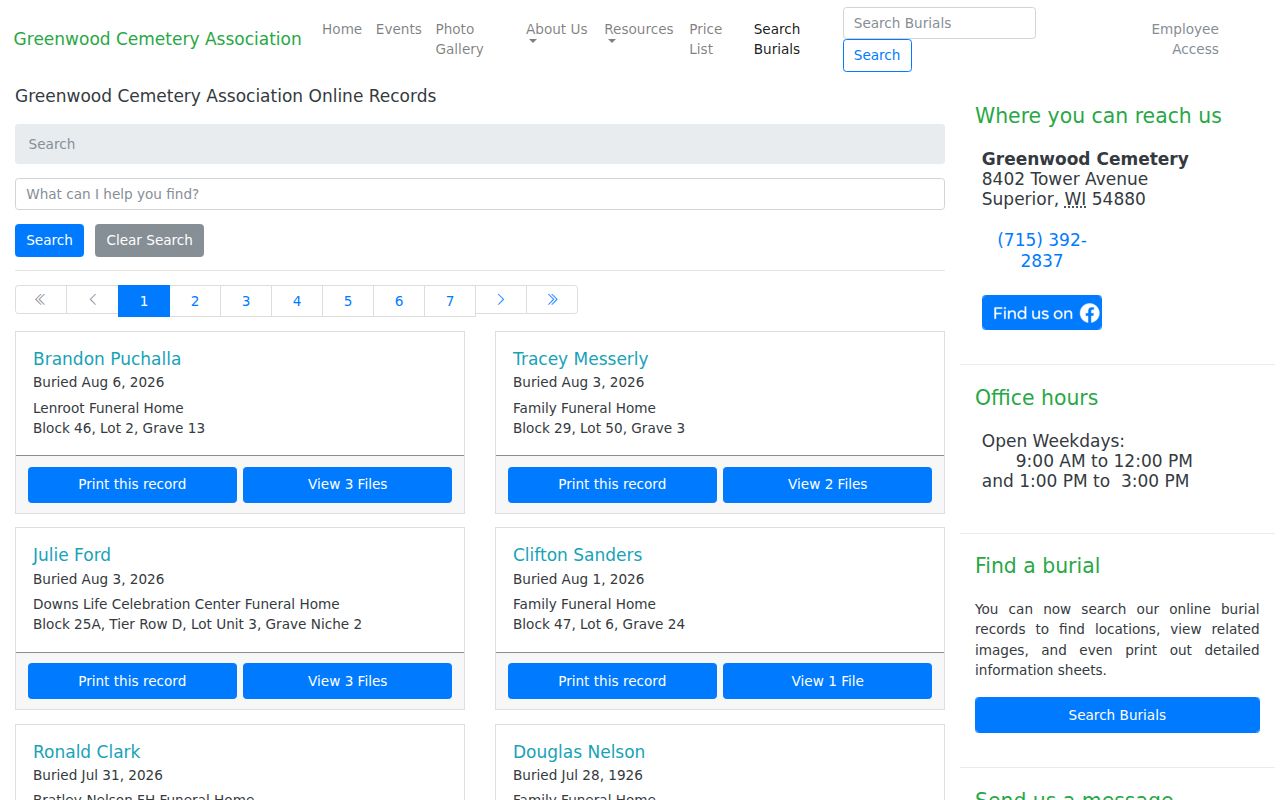
The result supplies a physical burial location and record identifiers, not a full life history. If no record appears, contact the cemetery office or check DPL and Macon cemetery references before ruling the person out.