
Decatur Previous Residents by Era
The best source depends on the date. A current parcel card leads to today's owner. Recorded instruments can move the title backward. A directory or census is stronger for actual household names, while a fire-insurance map describes the building and its setting. Decatur's trail is deep because county records begin near Macon County's formation and the library has a long directory run.
| Source | Years It Covers | Where Held | What It Shows |
|---|---|---|---|
| Recorder online index | June 1985 to current | Macon County Recorder | Recorded parties, deed type, date, legal trail |
| Deed books and indexes | 1829 to 1901 series | IRAD and county office | Earlier owners and conveyances |
| City directories | 1871 through today | Decatur Public Library | Listed residents, occupations, and addresses |
| Federal census | Public schedules through 1950 | NARA and library databases | Households and relationships |
| Sanborn maps | 1898, 1915, later updates | Library of Congress and UIUC | Building footprint, use, materials, nearby features |
| Obituary sources | 1878 forward | Decatur Public Library | Family ties, former addresses, life events |
Begin with the newest source that reliably names the parcel or address. Then step backward one transfer or one directory year at a time. Skipping decades makes it easy to attach the wrong family to a common surname or a street number that later changed.
Anchor Decatur's Current Address
The Macon County property search provides the present anchor. Search the street address, then save the owner, parcel number, separate situs and mailing addresses, legal description, sale history, and any published property card. The legal description is more durable than a postal label. It follows the land through records even when a street name or number causes trouble.
A tax owner is not proof that the person lived there. An owner may receive mail elsewhere, hold the property through an entity, or have inherited it. Still, the current name and latest sale date create the first link to the Recorder. The parcel number also opens the county GIS map, where lot shape and adjacent parcels can confirm that the right property was selected.
Note: Keep a dated copy of each parcel card because county ownership, sales, and assessment data change throughout the year.
Trace Macon County's Deed Chain
A chain of title is the sequence of recorded transfers for the same land. Macon County's free Fidlar Direct Search is data-only and currently works by party, date range, document number, document type, or reference number. Its address and parcel modes are disabled. That means previous-resident research begins with the assessor's current owner and legal description, then moves by names through the Recorder's index.
- Copy the current owner, parcel number, legal description, and latest sale date from the assessor record.
- Search that buyer in Macon County Direct Search. Match the purchase deed by date and legal information.
- Read the seller, or grantor, on that deed. Search the seller as a grantee to locate the seller's earlier purchase.
- Repeat the link while recording document numbers, dates, parties, and legal descriptions. Stop to resolve any break.
- At the June 1985 online boundary, contact the Recorder or move to older deed books and IRAD indexes.
- Grantor and grantee
- The grantor transfers an interest; the grantee receives it.
- Chain of title
- The linked sequence of recorded transfers for the same property.
- Legal description
- The formal land description, often by lot and block, that stays useful when a street address changes.
- Index versus image
- An index summarizes a record. The image is the recorded document itself.
The Recorder's office at 141 S Main Street, Room 201, provides the office and copy route. Laredo and Tapestry are paid options for broader searching or images. Direct Search results can show document number, type, recorded date, party columns, and legal information, but the configured public detail is limited.
Decatur Deeds Before the Web
The online cutoff is not the start of Macon County land records. The Illinois Regional Archives Depository guide lists Macon deed indexes from 1829 to 1893 and deed records from 1829 to 1901. Mortgage records span 1857 to 1893, and assessor books cover 1848 to 1891. Macon material is held at IRAD's University of Illinois Springfield depository.
The Recorder says the county tract index reaches back more than 150 years. A tract index organizes instruments by land rather than only by a person's name, which makes it valuable after a surname chain breaks. Ask the office which book, index, or paid service fits the date. For IRAD, supply Macon County, the series, the approximate year, the parties, and any legal description already found.
These older series reflect Decatur's role as county seat since 1830. They turn an apparent online dead end into an office-and-archive research step.
Ebel's Decatur Directory Legacy
Charles O. Ebel compiled Decatur directories whose entries now help connect names to older addresses. The Decatur Public Library biography of Ebel gives local context for the compiler. Its captured item page places the directory maker inside the city's own history collection.
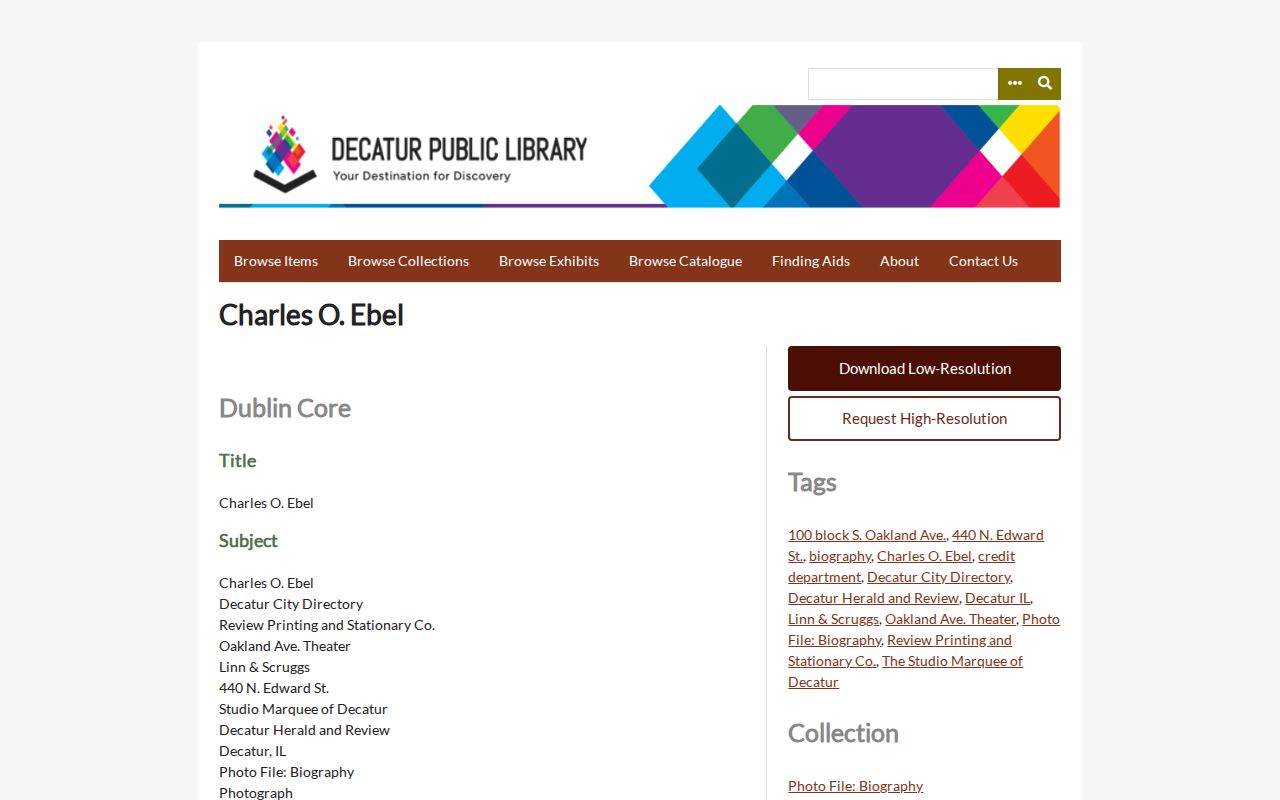
A directory entry is evidence for one publication year, not proof of a full span between volumes. Compare consecutive issues and mark the first and last appearance. If the surname disappears, search the address arrangement, spelling variants, obituaries, and the next census instead of assuming the household left at once.
Pair Decatur Directories and Census
Owners tell only part of a house story. Decatur Public Library holds city directories from 1871 through today, and the public federal census currently reaches 1950 under the 72-year release rule. Used together, they can add spouses, children, relatives, boarders, occupations, and changes between recorded transfers.
- Find the address in the directory year nearest a public census year. Copy every listed name and the exact street form.
- Locate the household in that census by name. Confirm relatives, ages, occupations, ownership status, and nearby households.
- Return to the next directory issue before and after the census. Mark arrivals, departures, and spelling changes.
- Compare the household names with the deed owner. A difference may point to a renter or family member, but it still needs support.
The full collection history and abbreviation keys are handled on the Decatur city directory page. For previous residents, the aim is narrower: establish who was listed at one address and when.
Decatur Houses on Sanborn Maps
Sanborn fire-insurance maps describe structures rather than residents. The 1898 Decatur set has 25 sheets. The 1915 Decatur set has 86 sheets, while the UIUC collection contains an index, 84 of 89 maps, and 1921 updates or additions. These sheets can show footprint, construction material, use, outbuildings, and nearby features.
Match the street, block, and surrounding landmarks before deciding that a mapped building is today's structure. A map may predate a later addition, demolition, or subdivision. Compare it with the current parcel shape, building sketch, permits, and directory entry from a nearby year. The map can explain why a family appears at an address before the present house existed or why one number once covered more than one building.
Note: Sanborn maps date a structure and its setting, but they do not identify previous residents without a directory, census, or other name source.
Close Decatur Household Gaps
Decatur Public Library's obituary index draws from source runs beginning in 1878 and can lead to family relationships, places, and dates. Obituary cards are index records, not the newspaper article. Ask for the cited item when the text is needed. Greenwood Cemetery's searchable interment records can supply burial details and relations where recorded.
Probate becomes important when a deed trail pauses around a death. IRAD lists Macon probate case files from 1830 onward. A file may explain how an interest passed to heirs or an estate, but availability and contents vary. Search the deceased owner's name, then compare the probate event with the next deed and directory change.
A focused library or archive request should name the person, address, date range, and source already checked. That gives staff enough context to search a volume, clipping file, or index without asking for an open-ended life history.
Judge Decatur Previous Resident Evidence
House history is strongest when independent records agree. A deed proves a recorded transfer, not occupancy. A directory places a listed name at an address for one issue. A census describes a household on its enumeration date. An obituary or probate file may connect family members and later events. Write down what each source actually says before combining the facts.
Conflicts are useful. A mailing address that differs from the situs may explain why an owner appears elsewhere. A directory name absent from the deed may be a renter or relative. A changed street label can create a false gap. Keep uncertain identities separate until another record supplies a date, relationship, legal description, or matching middle initial.
Lawful use. Research Decatur previous residents for house history, family history, estates, or personal curiosity. Never use the record trail to track, harass, intimidate, or harm a living person.
Restricted vital records, protected addresses, sealed matters, and withheld voter fields remain outside a public search. A missing web result can also mean the material is held only at a counter, library, or archive. Record the gap honestly and use the appropriate custodian rather than guessing.